Exposure time, camera shake, tripod and image stabilisation
Macro photography is not just about taking a large-format picture of a small object; it is also about monitoring the movement of both the subject and the camera. Even the slightest wobble in the camera can ruin the shot. As a result, you will usually need to use a tripod or set a much shorter exposure time than usual. If you are shooting handheld, which is extremely difficult with small objects and very short distances between them, image stabilisation in the camera or lens, or a combination of both, can allow a slightly longer exposure. However, subject movement remains.
Another physical effect influences the exposure and therefore the aperture and shutter speed. As you move the camera and lens closer and closer to an object, it will appear larger and larger, and will be captured with less and less light. The camera's automatic exposure system will of course compensate for this, but the exposure time parameter in particular will change less favourably at a constant aperture than when shooting at a distance.
Focus Bracketing
The shortcoming of shallow depth of field in macro photography can be overcome with a shooting technique called focus bracketing. As the name suggests, a series of moving-focus shots are stacked to create a single shot that is sharp from front to back. Most of the Canon EOS R cameras can even do this automatically, and the latest ones calculate the final result directly in the camera. Otherwise, the series of shots must be assembled using Canon's DPP software.
Macro illumination
Another way to compensate for the lack of light at large image scales without overloading the exposure time is to add external light sources. Canon offers two dedicated macro flashes that place their light sources directly on the lens, exactly where light is needed when the lens is very close to the subject. There are also accessories such as small LED lights that can be placed very close to the subject. LED flashlights are just as handy. But here's a tip: with this type of lighting, you should shoot in RAW format. LED lights that are so small and not specifically designed for photography do not have a defined light colour. The white balance should therefore be carefully adjusted in post-production.
Lenses
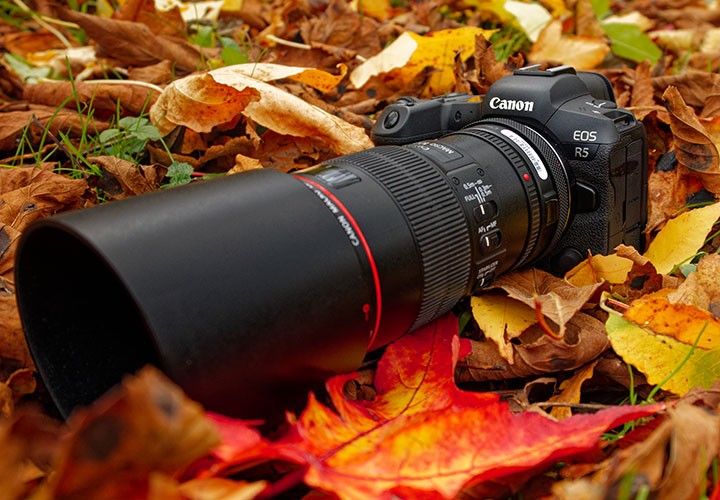
To achieve the large image scales described above, the camera and lens must be very close to the subject. The closest focusing distance of the lens should be correspondingly short. Special macro lenses are available, such as the RF 100mm F2.8 L Macro IS USM with a maximum magnification of 1.4mm. Special macro lenses are available, such as the RF 100mm F2.8L Macro IS USM with a maximum magnification of 1.4:1, or the EF 100mm 1:2.8L Macro IS USM with a maximum magnification of 1:1. Cheaper alternatives are either macro lenses that attach like a filter in front of a non-macro lens, reducing image quality, or extension tubes that attach between the lens and camera, reducing the close-up limit of a normal lens.